
 Available in US
Content

Eight years of reviewing bonus terms has taught me one reliable lesson: the headline number is almost never the number that matters. A £50 bonus with a 35x wagering requirement demands £1,750 in turnover before a single penny reaches your bank account. Most players never get there. Most players are not supposed to get there — that is the business model. Tombola operates on a different principle entirely: no wagering requirements on bonus funds. Whatever you receive, whatever you win from it, is yours to withdraw immediately.
That sounds like a marketing claim until you sit down with the maths. Tombola posted revenue of £164 million and an EBITDA of £38.5 million in its last independent financial year, with a 23 percent compound annual growth rate over five years. A company growing at that pace on wager-free bonuses is not making a charitable gesture — it has built a model where the economics work without locking players into playthrough cycles. Understanding how that model works, and where the catches still exist, is what this article covers.
How the No-Wagering Model Works at Tombola
I remember the first time I tried to explain wagering requirements to a friend who had just received a £20 bonus from an online casino. She thought she had been given £20. In a practical sense, she had been given access to £20 worth of play — and only if she managed to wager a total of £700 within 30 days would any winnings become withdrawable. She did not manage it. Hardly anyone does.

Tombola skips that entire mechanism. When the platform credits bonus funds to an account — whether through a welcome offer, a seasonal promotion, or a loyalty reward — those funds carry zero playthrough requirements. Win £15 from a bonus, and you can withdraw £15. No turnover threshold, no game-weighting restrictions, no forfeiture clock ticking in the background.

Peter Jackson, Flutter Entertainment’s CEO, described Tombola at the time of acquisition as a business with “a highly recreational customer base and focus on sustainable play.” That description cuts to the heart of the no-wagering approach. When players retain what they win, the relationship between platform and player shifts from adversarial to transactional. The operator earns through the house edge on games, not through a bonus structure designed to recapture funds before withdrawal becomes possible.
The mechanics are straightforward. Bonus funds appear in the account balance alongside real funds. There is no separate “bonus wallet” that must be cleared before real money becomes accessible. Games do not contribute at different percentages — a pound wagered on bingo counts the same as a pound wagered on an arcade game. This simplicity is itself unusual in an industry that has turned bonus terms into multi-page legal documents.
The Maths: What You Keep vs a Standard Wagering Bonus
Numbers cut through marketing faster than any review. The global online bingo market was valued at $3.22 billion in 2025 with a projected CAGR of 6.5 percent, and a significant portion of that market relies on wagering-requirement bonuses to convert deposits into long-term play. Here is what the standard model looks like in practice versus what Tombola offers.
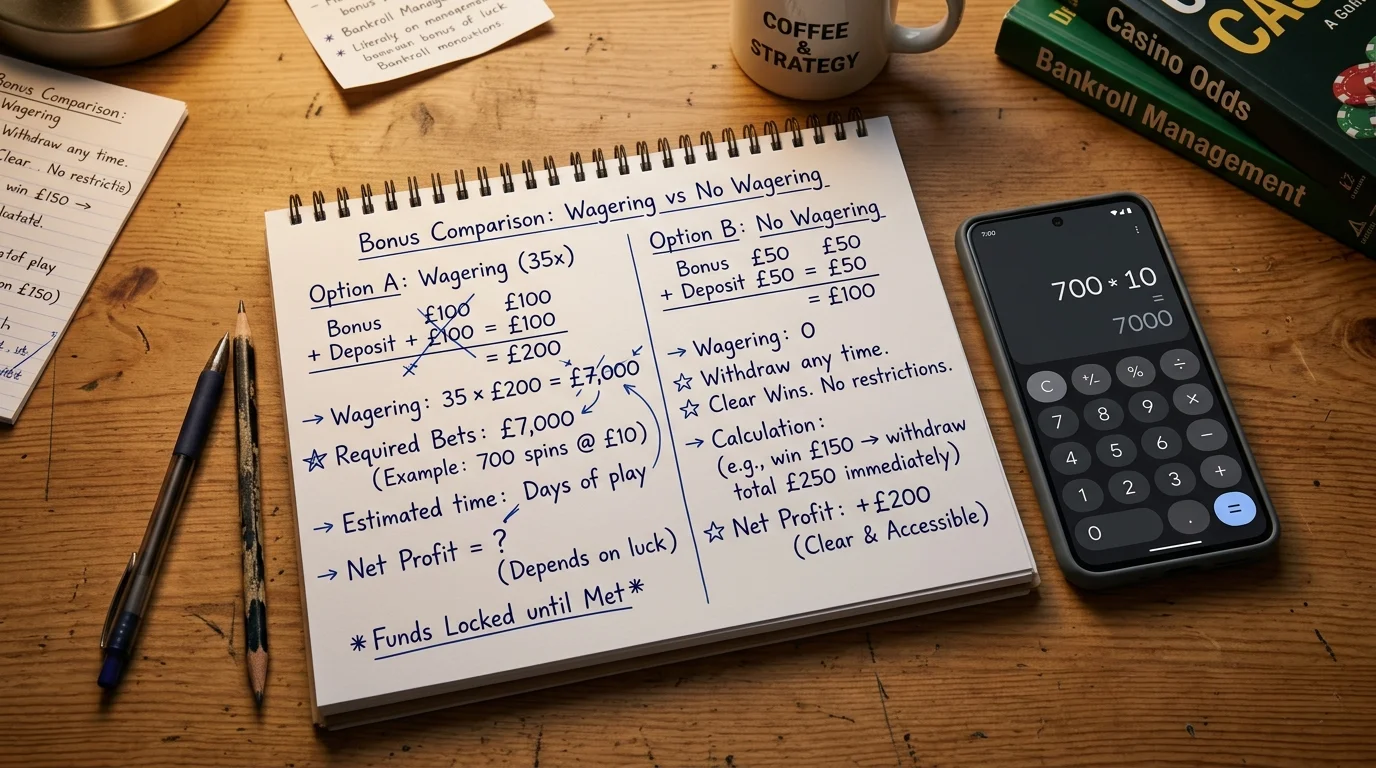
Take a hypothetical £20 bonus with a 35x wagering requirement — a common industry figure. The player must wager £700 before any winnings can be withdrawn. Assume the player is playing a game with a 95 percent RTP, which is generous for the slot category. On average, after wagering £700, the expected return is £665 — a loss of £35 from the wagering activity alone. The bonus has, statistically, cost the player more than the bonus itself was worth. The £20 “gift” has generated £35 in expected losses.

Now consider the same £20 bonus under Tombola’s no-wagering model. The player receives £20, plays at the same 95 percent RTP, and can withdraw at any point. If they wager the full £20 once and win £19, they withdraw £19. No further obligations. The expected loss from one round of wagering at 95 percent RTP on a £20 stake is £1 — not £35.
The difference compounds at higher bonus amounts. A £100 bonus with 35x requirements means £3,500 in wagering and an expected loss of £175 at 95 percent RTP. That same £100 with no wagering requirement costs, on a single round of play, an expected £5. The mathematical advantage of the no-wagering model is not marginal — it is an order of magnitude.
This does not mean every player walks away in profit. The house edge still applies to every game, every session. Tombola’s revenue model depends on players continuing to play because they enjoy it, not because they are trapped in a wagering cycle they cannot escape. The distinction is between losing money voluntarily over time and losing money because the bonus terms made it inevitable.
Terms That Still Apply Even Without Wagering
A colleague once told me that the three most dangerous words in gambling marketing are “no strings attached.” There are always strings. Tombola’s no-wagering model eliminates the most punishing one, but other conditions remain, and ignoring them can still lead to forfeited funds.

Time limits apply. Bonus funds are not permanent additions to an account — they typically come with an expiry window. If the bonus is not used within the specified period, it is removed. The window varies by promotion, so checking the specific terms for each offer matters. A welcome bonus might allow seven days; a seasonal promotion might give 48 hours.
Eligibility restrictions exist. Not every account qualifies for every bonus. Welcome offers are limited to new accounts, one per household, one per IP address. Attempts to create duplicate accounts to claim multiple bonuses violate the platform’s terms and will result in account closure and forfeiture of all funds — bonus and real money alike.
Game restrictions can apply to specific promotions. While Tombola’s general bonus policy does not weight games differently for wagering purposes — because there is no wagering requirement — individual promotions may be tied to specific game categories. A bingo-specific bonus might not be usable on arcade games, for instance. The terms of each promotion specify which games are included.
Maximum withdrawal limits from bonus funds may apply in some cases. This varies by promotion and is always specified in the terms. It is less common at Tombola than at operators running high-wagering bonuses — where withdrawal caps serve as an additional layer of protection against players actually clearing the requirements — but it is worth checking regardless.
Finally, identity verification must be completed before any withdrawal, whether from bonus or real funds. This is a regulatory requirement under UKGC rules, not a Tombola-specific policy, but it catches some new players off guard. Uploading identification documents before attempting a first withdrawal avoids delays.
What Wager-Free Really Changes for the Player
The practical effect of no-wagering bonuses extends beyond the maths. Over the years I have noticed a pattern: players on high-wagering bonuses change their behaviour. They chase the requirement, increasing bet sizes or switching to higher-volatility games in an attempt to clear the threshold before the clock runs out. That behaviour is exactly what responsible gambling frameworks are designed to prevent — and yet the bonus structure incentivises it.
Tombola’s model removes that incentive entirely. There is no threshold to chase, no reason to increase stakes beyond what the player is comfortable with, no countdown timer creating urgency. The bonus becomes what most players assumed it was when they first saw it: a small amount of free play. Nothing more, nothing less. In an industry where the gap between player expectation and contractual reality is often measured in thousands of pounds of wagering, closing that gap is a meaningful change.
Are there any time limits on using a Tombola no-wagering bonus?
Yes. Most Tombola bonuses carry an expiry window, typically ranging from 48 hours to seven days depending on the promotion. Unused bonus funds are removed from the account once the window closes. The specific time limit is stated in the terms of each individual offer.
Do all Tombola games count equally towards the bonus?
Tombola does not apply game-weighting percentages because there is no wagering requirement to clear. However, some individual promotions may be restricted to specific game categories — a bingo bonus may only be usable in bingo rooms, for example. The terms of each promotion specify which games are eligible.