
 Available in GB
Content
- Current Welcome Offer: Structure, Amounts and Eligibility
- No-Wagering Policy: How It Works and What You Actually Keep
- Minimum Deposit, Payment Windows and Qualifying Methods
- Ongoing Promotions and Reload Offers Beyond the Welcome Bonus
- Tombola's Bonus Model vs Standard Industry Wagering Requirements
- Post-Claim: What Happens After Bonus Activation
- Bonus Questions Answered

I spent the better part of a decade reviewing bonus structures across UK-licensed bingo and casino platforms, and the single question that separates a genuinely useful offer from a marketing trap is always the same: what do you actually get to keep? That question is where Tombola’s approach diverges from almost every competitor in the market. While the global online bingo sector — valued at $3.22 billion in 2025 and growing at a compound annual rate of around 6.5% — remains dominated by operators who dress up their welcome packages with 30x, 40x, even 50x wagering requirements, Tombola runs its entire bonus programme on a wager-free basis. No playthrough multiples. No hidden conversion caps. No forfeiture clauses buried in paragraph nine of the terms.
That sounds like a simple proposition, and in a sense it is. But simplicity in iGaming bonus design is rarer than it should be — and the financial implications for players are substantial. A wager-free bonus means every penny of winnings derived from bonus funds belongs to the player immediately. There is no rollover loop draining your balance through forced bets, no strategic game selection to minimise house-edge erosion during wagering, and no countdown timer pressuring you into higher-risk play. The maths, quite literally, changes.
This article breaks down Tombola’s current bonus offer for 2026 in full — the welcome package, deposit terms, ongoing promotions and how the no-wagering model stacks up against the standard industry approach. I will walk through the numbers, explain what each term means in practice, and cover the parts that marketing copy tends to skip. If you are evaluating where to play bingo online in the UK, understanding how bonus structures really work is the single most valuable piece of homework you can do before depositing a penny.
Current Welcome Offer: Structure, Amounts and Eligibility
A few years back, I sat in on a panel at ICE London where three affiliate managers debated whether “generous” was the most overused word in iGaming copy. They were right — it is — but it also disguises the fact that most welcome bonuses are structured to give back far less than the headline number implies. Tombola’s current welcome offer avoids that trap, though it is deliberately modest compared to the eye-watering figures some slot-heavy operators wave around.
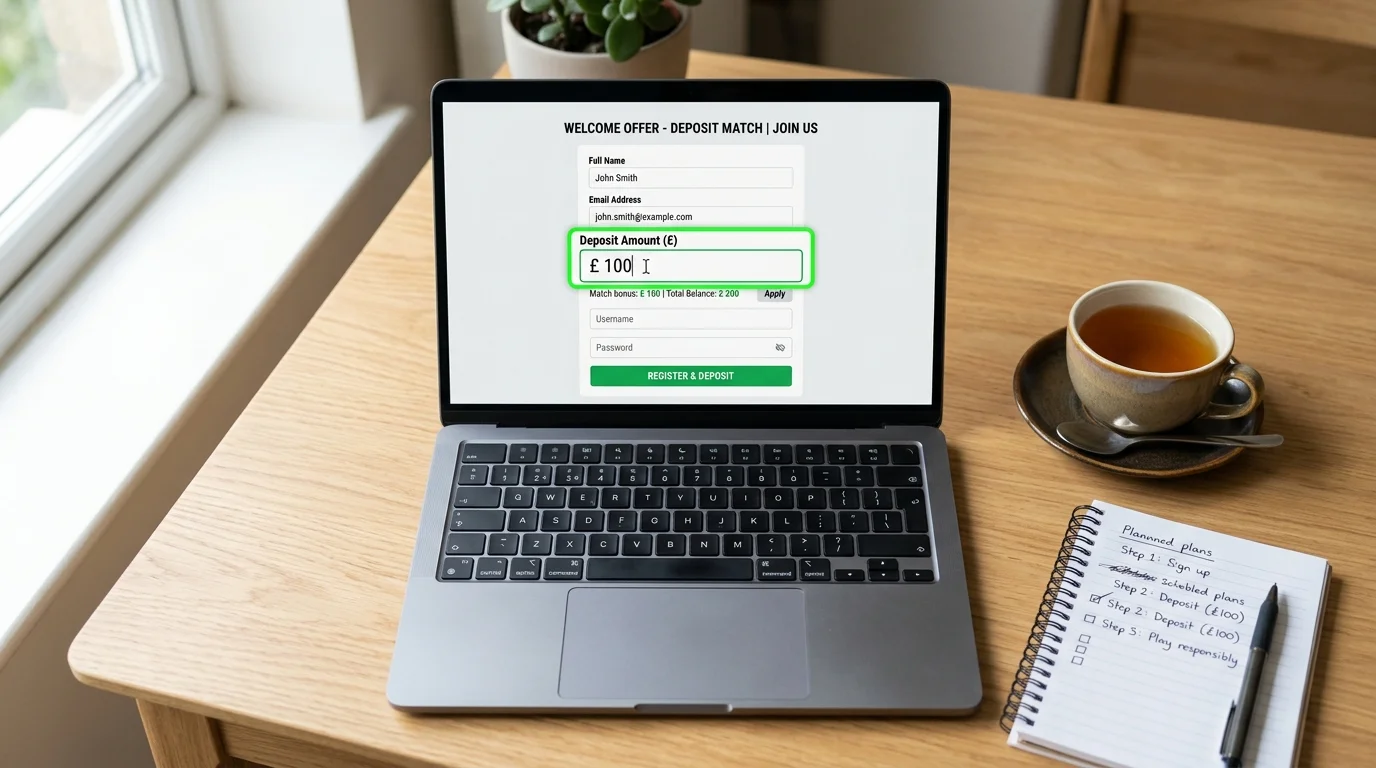
The offer works like this: new players who register a Tombola account and make their first deposit receive bonus funds added to their balance. The exact structure and percentage can vary — Tombola has historically run both 100% and 200% match formats at different points — so the specific terms displayed on the registration page at the time of sign-up are the ones that apply. What does not change is the core mechanic: the bonus is wager-free. Whatever you win using those bonus funds, you withdraw. Full stop.
Eligibility is straightforward. You need to be a new customer, aged 18 or over, with a verified UK address. One account per person, per household, per IP address — standard anti-abuse conditions that every UKGC-licensed operator enforces. The deposit must be made using a qualifying payment method within a specified window after registration. If you miss that window, the bonus lapses. There is no manual opt-in code required through the main Tombola site, though promotional codes may apply to specific seasonal variations of the offer.
One detail worth noting: Tombola’s welcome offer is designed around its bingo and proprietary game library, not around third-party slots. That means the bonus funds are intended for use within Tombola’s own titles. If you are expecting to funnel bonus money into a Pragmatic Play or NetEnt slot, this is not the platform for that — Tombola does not carry third-party games. The bonus is purpose-built for the games Tombola develops in-house, which is consistent with the broader business model.
I have seen players dismiss Tombola’s offer as “small” compared to operators dangling £200 or £500 match bonuses. That reaction misses the point entirely. The value of a bonus is not the number on the banner — it is the number in your bank account after you have met all the conditions. And that is where wager-free changes everything, which brings us to the next section.
No-Wagering Policy: How It Works and What You Actually Keep
Here is a scenario I have walked through with dozens of readers over the years, and it never stops being illustrative. Suppose two players each receive a £20 bonus. Player A is at an operator with a 35x wagering requirement. Player B is at Tombola. Both play bingo, both have a decent session, and both end up with £50 in winnings from their bonus funds. Player B withdraws £50. Player A? Player A needs to wager £700 — that is 35 times the £20 bonus — before a single penny becomes withdrawable. During those £700 worth of forced bets, the house edge is constantly working against them. On a game with a 5% house edge, the expected loss across £700 in wagers is £35. The £50 win evaporates into £15, if anything survives at all.
That is not a hypothetical. That is the standard maths of wagering requirements across the UK online gambling market, and it is the reason the no-wager model matters.
Tombola’s policy strips that entire layer away. When you win using bonus funds, the winnings are real cash. They sit in your withdrawable balance immediately. There is no playthrough counter ticking down in the background, no distinction between “bonus balance” and “real balance” once you have played. The transparency of this model was one of the factors that attracted Flutter Entertainment’s attention. Peter Jackson, Flutter’s CEO at the time of the acquisition, described Tombola as a business with a “highly recreational customer base and focus on sustainable play” — and a wager-free bonus structure is a direct expression of that philosophy.
Tombola generated revenue of £164 million with an EBITDA of £38.5 million in the financial year before the acquisition, demonstrating that a wager-free model can be commercially viable at scale. The company does not need to trap players in rollover cycles to sustain its margins. Instead, it relies on high volume, low stakes and a game library that keeps players coming back because they enjoy the experience — not because they are chasing locked funds.
For players, the practical implication is that bonus evaluation becomes dramatically simpler. You do not need to calculate expected value after wagering erosion. You do not need to hunt for low-house-edge games to grind through a playthrough requirement. You deposit, you receive the bonus, you play, and whatever comes out the other side is yours. The only condition is that you use the bonus funds within the specified timeframe — typically a few days — or they expire. That is the one constraint worth watching.
I would argue this is the single most important feature of Tombola’s bonus programme. Not the headline number, not the percentage match, but the fact that the number you see is the number you get. In an industry where complexity is routinely used to obscure value, clarity is a competitive advantage.

Minimum Deposit, Payment Windows and Qualifying Methods
I once received an email from a reader who had signed up at a well-known casino, deposited £5 via an e-wallet, and discovered two days later that e-wallet deposits did not qualify for the welcome bonus. The terms were there, buried in a scrollable text box during registration, but the point is that bonus conditions around deposits are where a lot of players get tripped up — not by the wagering, but by the mechanics of getting the bonus in the first place.
Tombola keeps its deposit requirements comparatively clean. The minimum deposit to trigger the welcome offer is set at a level consistent with the platform’s low-stakes positioning. Tombola has historically maintained minimum deposits in the £10 range, though the precise figure can shift with promotional cycles, so the terms displayed at sign-up are the binding reference. The deposit must be made within a defined window after account creation — miss that window, and the offer expires with no option to reinstate it.
Qualifying payment methods typically include debit cards (Visa and Mastercard), PayPal and bank transfers. Credit card gambling has been banned across all UKGC-licensed operators since April 2020, so that is not an option anywhere, not just at Tombola. The key detail is that most mainstream payment methods available on the platform qualify for the bonus — there is no carve-out excluding e-wallets the way some operators structure their terms.
Processing times matter here as well. A deposit via debit card is usually instant, meaning the bonus funds land in your account within minutes. PayPal deposits tend to process similarly fast. Bank transfers, depending on the bank, can take longer — and if that delay pushes you past the qualifying window, the bonus will not trigger. My standing advice: if you intend to claim the welcome offer, use the fastest deposit method available and do it promptly after registration. There is no strategic reason to delay.

One more point on deposit terms that often gets overlooked: Tombola does not require a minimum number of games played before a deposit qualifies. Some operators impose a “deposit and play” condition where the funds must be wagered at least once on a qualifying game before the bonus activates. Tombola’s structure is more direct — deposit, receive the bonus, play when you are ready. That distinction might seem minor, but in an industry where conditions compound, every layer of simplicity has value.
Ongoing Promotions and Reload Offers Beyond the Welcome Bonus
The welcome bonus gets the headlines, but what happens on day thirty is often more revealing than what happens on day one. I have tracked operators who pour their entire marketing budget into acquisition offers and then go completely silent once the welcome period ends — no reload bonuses, no loyalty mechanics, nothing. Tombola takes a different approach, running a rotating calendar of promotions that extends well beyond the initial deposit match.
Tombola’s ongoing promotions typically fall into a few categories. There are daily and weekly prize draws tied to specific game rooms, where buying tickets during a promotional window enters you into an additional draw on top of the regular game prizes. There are reload deposit bonuses that appear periodically, offering existing players a percentage match on a subsequent deposit. And there are seasonal promotions — tied to events, holidays or game launches — that introduce limited-time mechanics or enhanced prize pools.
Tombola holds the highest level of responsible gambling accreditation in the UK — GamCare Level 3 Safer Gambling Standard — and that accreditation shapes how promotions are designed. You will not find aggressive push marketing or countdown-timer pressure tactics. Promotional communications tend to be informational rather than urgent, and opt-out mechanisms are prominent. This is consistent with what the UKGC has been pushing across the industry: promotional material should inform, not pressure.
The reload offers deserve particular attention because they follow the same wager-free logic as the welcome bonus. When a reload promotion offers a 50% match on a deposit, the resulting bonus funds carry no playthrough requirement. You play, you win, you keep it. That consistency across the entire promotional calendar is unusual. Many operators apply wager-free terms to the welcome offer as a headline-grabber and then quietly revert to standard wagering on all subsequent promotions. With Tombola, the no-wager policy is a platform-wide principle, not a marketing stunt.
I would note that the frequency and value of ongoing promotions at Tombola is generally lower than at high-volume slot operators, which is a trade-off of the low-stakes, bingo-focused model. You are not going to see £500 weekly cashback or VIP-tier reload matches. What you get instead is a steady, predictable stream of smaller offers that are genuinely usable — and that, for a recreational player spending £10 or £20 a week, tends to be a better fit than headline numbers designed for high rollers who will never meet the wagering anyway.

Tombola’s Bonus Model vs Standard Industry Wagering Requirements
Let me put some numbers on the table, because this is where the difference between a wager-free model and the industry standard becomes impossible to ignore. The Bingo Duty — first introduced in the 1960s and set at its most recent rate of 10% from 2014 (the rate had been 20% before then) — was abolished entirely from 1 April 2026. The UK government described bingo as a “relatively harmless activity” when announcing the abolition, which tells you something about how regulators view the risk profile of this sector compared to slots or sports betting. At the same time, Remote Gaming Duty — the tax on online gambling revenue — was nearly doubled, rising from 21% to 40%. That reshuffling of the tax landscape is significant context for how operators structure their bonus economics.
The standard bonus model across UK online gambling works on a principle I explained earlier in this article, but the industry-wide picture adds another dimension. The wagering requirement is not just a player-facing mechanic — it is a revenue engine. Operators set wagering multiples at levels calibrated to recapture most or all of the bonus value through house-edge erosion. The higher the multiple, the more the player must wager, and the more the house edge compounds. At 35x, the expected recovery for the operator on a typical slot is over 100% of the bonus amount. At 50x, it is closer to 200%. The bonus is not a cost to the operator — it is a profit centre disguised as generosity.
Tombola’s model inverts that dynamic entirely. Without a wagering multiplier, there is no forced-bet cycle for the house edge to compound through. The operator absorbs the bonus as a genuine acquisition cost, offset by the revenue generated from the player’s ongoing activity. That requires confidence in the product’s retention power — a confidence backed by Tombola’s track record of sustained growth, including a 23% compound annual revenue growth rate over the five years preceding the Flutter acquisition.
Here is the comparison distilled into a concrete scenario. Take a hypothetical £25 bonus at three different operators:
Operator with 35x wagering: £875 in required bets, expected loss of approximately £35 at 4% house edge. Net expected value: -£10. The bonus costs you money.
Operator with 20x wagering: £500 in required bets, expected loss of approximately £20 at 4% house edge. Net expected value: roughly £5. Marginal benefit.
Wager-free operator (Tombola model): No required bets beyond normal play. Expected loss on £25 of play at 20% margin: £5. Net expected value: approximately £20. The bonus has real, positive value.
The gap is stark, and it widens as wagering requirements increase. At 50x, which some operators impose, a £25 bonus requires £1,250 in wagers and carries an expected loss of £50 — double the bonus amount. Players are mathematically better off refusing the bonus entirely.
None of this is secret information, but it is information that the industry rarely presents in plain terms. The standard affiliate model relies on promoting big headline numbers, and a 200% match up to £500 with 45x wagering will always look more impressive in a comparison table than a modest wager-free offer. The numbers tell a different story — one that consistently favours the player who keeps the maths simple and the conditions clean.

Post-Claim: What Happens After Bonus Activation
So you have deposited, the bonus has landed, and your balance shows both your cash deposit and the bonus funds. What now? This is the stage where a lot of players — particularly those coming from wagering-heavy operators — expect complications. They look for the playthrough counter, the game-eligibility restrictions, the percentage contribution charts. At Tombola, there is none of that.
Once the bonus is activated, it functions as playable funds across Tombola’s game library. You can use it to buy bingo tickets, play instant-win titles, or try the proprietary number games — whichever appeals. There is no tiered contribution system where bingo counts 100% but arcade games count 10%. The bonus balance is simply available, and the winnings from it are simply yours.
The one thing to watch is the expiry window. Bonus funds that remain unused after the specified period — typically a few days from activation — will be removed from your account. This is not unique to Tombola; virtually every operator imposes an expiry on bonus funds to prevent indefinite sitting on free money. The practical implication is simple: do not claim the bonus unless you intend to play within the next few days. If you are registering for curiosity and plan to come back in a month, make your first deposit when you are actually ready to play.
Withdrawals of winnings generated from bonus play follow the same process as standard withdrawals. Tombola does not impose a separate verification layer or a pending period specifically for bonus-derived winnings. The standard KYC — Know Your Customer — process applies to all withdrawals: identity verification, proof of address, and potentially source-of-funds checks for larger amounts. These are regulatory requirements, not bonus conditions, and they apply whether your winnings came from bonus play or cash play.
After the welcome bonus expires or is used, your account transitions into the regular promotional cycle. Reload offers, daily draws, seasonal promotions — the ongoing programme covered earlier in this article — kick in from there. There is no “dead zone” between the welcome offer and ongoing promotions, which is a design choice that keeps new players engaged without relying on bonus desperation to drive continued deposits.

Bonus Questions Answered
Can I combine the Tombola welcome bonus with other promotions?
The welcome bonus is a standalone offer tied to your first qualifying deposit. It cannot be stacked with other promotional offers running at the same time. Once the welcome bonus has been claimed or has expired, you become eligible for Tombola’s ongoing promotional calendar, which includes reload offers, daily draws and seasonal promotions. Each subsequent promotion operates independently with its own terms.
What happens to my bonus if I do not meet the deposit deadline?
If your qualifying deposit is not made within the specified window after account registration, the welcome bonus offer expires permanently. There is no mechanism to reinstate or extend the deadline. If you register an account but are not ready to deposit immediately, it is worth noting the exact timeframe displayed during sign-up so you can plan accordingly.
How does a no-wagering bonus save money compared to a standard 35x rollover?
With a standard 35x wagering requirement on a 25-pound bonus, you would need to place 875 pounds in total bets before withdrawing. At a typical 4% house edge, the expected loss during that wagering process is roughly 35 pounds — more than the bonus itself. A wager-free bonus skips that entire cycle: your winnings from bonus play are immediately withdrawable, so the only cost is the house edge on the games you actually choose to play during your session.
Are free spins included in the Tombola welcome offer?
Tombola’s welcome offer is structured as a deposit match bonus rather than a free-spins package. Because Tombola develops all of its games in-house and does not carry third-party slot titles, the traditional free-spins mechanic used by slot-focused operators does not apply. Bonus funds can be used across the full range of Tombola’s proprietary games, including bingo rooms and instant-win titles.